Showing posts with label Law. Show all posts

Tuesday, November 2, 2021

Will "outcry" over ugly details of latest Oklahoma execution impact its plans to have six more in coming months?

The question in the title of this post is prompted by the first word of the headline, and then the last sentence of the body, of this new Guardian piece: "Outcry after Oklahoma prisoner vomits and convulses during execution."  Here are the basics:

Oklahoma is coming under sharp criticism after witnesses to the state’s first judicial killing for six years described gruesome scenes of the dying prisoner convulsing and vomiting as he was administered the lethal injections.

John Grant, 60, was pronounced dead at 4.21pm on Thursday at McAlester state penitentiary after he was injected with a triple cocktail of midazolam, vecuronium bromide and potassium chloride. Later, the department of corrections said the killing had gone “in accordance with protocols and without complication”.

But eyewitness accounts from reporters at McAlester’s supposedly state-of-the-art death chamber gave a very different account.  Dan Snyder, an anchor at the Oklahoma TV channel Fox 25, said that events went drastically off course the instant the first drug, the sedative midazolam, was injected into the prisoner.  “Almost immediately after the drug was administered, Grant began convulsing, so much so that his entire upper back repeatedly lifted off the gurney,” Snyder reported. “As the convulsions continued, Grant then began to vomit.  Multiple times over the course of the next few minutes medical staff entered the death chamber to wipe away and remove vomit from the still-breathing Grant.”

It took 15 minutes for Grant to be declared unconscious by medical staff, after which the vecuronium bromide, which paralyses the body, and potassium chloride, which stops the heart, were given. On Twitter, Snyder gave his response to the state’s official claim that all had gone according to plan. “As a witness to the execution who was in the room, I’ll say this: repeated convulsions and extensive vomiting for nearly 15 minutes would not seem to be ‘without complication’.”

Accounts of the botched execution of Grant, who was being put to death for the murder in 1998 of a prison cafeteria worker while he was already serving a sentence for armed robberies, will come as a deep embarrassment for Oklahoma. No judicial killings have taken place in the state since 2015 after a spate of botched procedures caused widespread alarm and forced the authorities to review their use of lethal injection drugs.

In 2018, officials in the state went as far as to announce they would abandon lethal injections entirely, due to the protocol’s lack of transparency and to the inhumane executions that had taken place. But in August the state reversed that decision, saying it would resume executions without giving an explanation for the U-turn or revealing critical details about how it intended to carry out the killings.

The state’s six-year hiatus was prompted in part by the execution in 2014 of Clayton Lockett, who writhed and groaned on the gurney for 43 minutes before he was declared dead after the intravenous line through which the lethal drugs were delivered was inserted improperly. The gruesome descriptions of his death by eyewitnesses in the Guardian and elsewhere caused nationwide revulsion. The following year the state used the wrong drug to kill Charles Warner. In the wake of these botched procedures a bipartisan commission reviewed the state’s death penalty system and issued a highly critical report that called for the moratorium on capital punishment to be extended....

Grant’s execution was allowed to proceed on Thursday after the US supreme court voted five to three, with the three liberal justices dissenting, to allow the judicial killing to go ahead. It is unclear whether the descriptions of his death will affect future planned executions in the state.

Oklahoma has an aggressive calendar of executions scheduled, with six set to take place by the end of March.

I put the word "outcry" in quotes because, so far, I have mostly seen opponents of the death penalty comment and assail the latest ugly Oklahoma execution.  If only the "usual subjects" are complaining about the execution, I doubt that will slow the state's current plan to execute another half-dozen people in the coming month. But it also seems possible, especially if more evidence of problems with the execution process emerges, that some death penalty supporters in Oklahoma or elsewhere will express concern and be in a position to slow future trips to the death chamber.

Prior recent related posts:

UPDATE: This local article suggests that Oklahoma officials are not troubled by the execution of John Grant. Here is how it stars:

Oklahoma Department of Corrections Director Scott Crow said Friday the agency has no plans to change its execution protocol after a witness said John Marion Grant had about two dozen full body convulsions and vomited during his lethal injection on Thursday.  “Some of the information is either embellished or is not exactly on point,” the DOC director said during a virtual press conference to “clarify” issues.

Crow, who witnessed the execution, said he saw Grant dry heave fewer than 10 times, not convulse. He said Grant did vomit.  “As he started that process, I conferred with the physician we had on site monitoring the process and he advised me that regurgitation is not a completely uncommon instance or occurrence with someone that is undergoing sedation,” Crow said.

Via Law http://www.rssmix.com/

"Bloody Lucre: Carceral Labor and Prison Profit"

The title of this post is the title of this new article authored by Laura Appleman and now available via SSRN.  Here is its abstract:

The pursuit of profit is inextricably intertwined with America’s system of carceral labor and criminal punishment.  Along with the institution of slavery, the harnessing of involuntary carceral labor yielded enormous proceeds through transformation of human toil into financial gain.  Profit incentives have exerted a profound influence on the shape of American carceral labor.  From 16th-century British convict transportation to 21st-century private corrections companies, profitable returns from involuntary carceral servitude have been an important feature of criminal punishment.

This Article traces the coruscating power of the private profit motive within the criminal justice system, one of the first to chart the ways this focus on revenues has shaped the forced toil of those under correctional control.  By thoroughly evaluating our carceral history, and dissecting the financial currents that have shaped the many forms of involuntary inmate servitude, we will be better able to disentangle how money has influenced and warped our system into one of mass incarceration.  Moreover, a full understanding of our carceral past could help us begin to rechart the course of modern criminal justice, eliminating this kind of involuntary servitude in our system.

Via Law http://www.rssmix.com/

[Eugene Volokh] Russia Is the Homeland of the Horse

[Russian horses are the winners, and all the others are losers.]

Not a joke (cf. "Russia is the homeland of the elephants," which refers to the Soviet government's habit of claiming that all great things came from Russia); from the National Geographic (Rebecca Dzombak):

Because people in the Volga-Don region bred horses for domestication and quickly began migrating to new places with them, this new line of horses soon spread from western Europe to eastern Asia and beyond.

The migration "was almost overnight," says [molecular archaeologist Ludovic] Orlando, whose study was published on October 20 in Nature. "This was not something that built up over thousands of years."

"As they expanded, they replaced all the previous lineages that were roaming around Eurasia," he says. The domestic horse we know today "is the winner, the one we see everywhere, and the other types are sort of the losers."

Via Law http://www.rssmix.com/

[Eugene Volokh] Kisses, Huma Abedin, and Gradual Escalation

[What are the social norms?]

I was filing a friend-of-the-court brief recently—hold on, this will get relevant—and was corresponding with the counsel for the parties: Federal Rule of Appellate Procedure 29(a)(2) requires that the brief either be accompanied with a motion for leave or "state[] that all parties have consented to its filing," so I e-mailed the parties asking, "Would you consent to the filing of the brief, so that we can file it without drafting an accompanying motion for leave?" The side we are supporting responded promptly with "Appellees consent," but the other side responded with "No objection."

No objection? Wait, is that consenting to the filing? Or just saying that they won't file an opposition to our motion for leave, if we file a motion? I wasn't going to tell the judges that the parties "have consented" when one of them merely wasn't objecting.

So I responded with, "just to confirm, may I note that as your consenting to the filing of the brief." Not hearing back, I e-mailed again, "Sorry to trouble you, but I just wanted to confirm that you indeed consent." Then I got back, "Yes that's fine," and I figured that was enough.

By sheer coincidence, I was planning on kissing a woman that day …. No, actually, that wasn't it (these days, I only kiss my wife, and we aren't on Rule 29(a)(2) terms); but I do remember, back in the day, 35 years ago now, I was talking to an older female friend of mine about a woman I had indeed asked for permission to kiss, and my friend told me quite firmly that women didn't like to be asked about that.

And now to Huma Abedin: The Guardian reported, based on its review of Abedin's not-yet-released memoir,

[Headline:] Longtime Hillary Clinton aide Huma Abedin describes sexual assault by US senator …

Abedin details her alleged assault while describing her work for Clinton when the former first lady and future secretary of state and presidential candidate was a US senator from New York, between 2001 and 2009….

[A]fter describing a Washington dinner attended by "a few senators and their aides" but not Clinton, Abedin writes: "I ended up walking out with one of the senators, and soon we stopped in front of his building and he invited me in for coffee. Once inside, he told me to make myself comfortable on the couch."

She says the senator took off his blazer, rolled up his sleeves and made coffee while they continued to talk.

"Then, in an instant, it all changed. He plopped down to my right, put his left arm around my shoulder, and kissed me, pushing his tongue into my mouth, pressing me back on the sofa.

"I was so utterly shocked, I pushed him away. All I wanted was for the last 10 seconds to be erased."

Abedin writes that the senator seemed surprised but apologized and said he had "misread" her "all this time". As she considered how to leave "without this ending badly", she writes, the senator asked if she wanted to stay.

"Then I said something only the twentysomething version of me would have come up with—'I am so sorry'—and walked out, trying to appear as nonchalant as possible." …

Abedin later followed up that she did not consider it sexual assault (and also that the senator was someone she "knew and … was very comfortable with"), and I think that's right: An unwanted open-mouthed kiss, generally isn't considered sexual enough to be sexual assault. (California law, for instance, defines misdemeanor "sexual battery" as touching "the sexual organ, anus, groin, or buttocks of any person, and the breast of a female" "against the will of the person touched, … for the specific purpose of sexual arousal, sexual gratification, or sexual abuse.")

At the same time, this did make me wonder: Is this indeed something that should be seen as at least improper behavior (whether or not illegal), or just as a nonculpable misreading of the signals that led to an awkward situation? My general sense of "the rules," at least back when I was dating in the mid-1980s to early 2000s, was what one might call "gradual escalation": Some degree of acquaintance (could be very short, if the meeting was in certain kinds of contexts) and conversation, followed by kissing, followed by more touching, followed by undressing, followed by sex of various sorts; instead of asking for overt permission, one of the parties (usually the man, but could be the woman) would try the next step, and then see if that was rebuffed.

Skipping steps (e.g., kissing a total stranger, touching breasts without kissing or something like that in between, etc.) was bad, trying a rebuffed step (in the absence of some indication of greater interest) was bad, but merely trying the next step and learning that it wasn't wanted was seen as potentially awkward but not reprehensible. If you want to map this to the legal rules, one might think of (say) kissing someone after what you thought was an interaction that reflect some interest as involving a known risk that the kiss wouldn't be welcomed, but in context it wasn't seen as a "substantial and unjustifiable risk" and thus wasn't what the criminal law would call "reckless."

I personally liked the idea of more express consent; I don't think much would be lost in life if that were the norm in romantic contact and not just in appellate briefing. My sense, though, is that just was quite far from the custom.

But that was just my recollection, so I decided to ask several close female friends of mine, whom I've known for decades, for their thinking on the subject; with their permission, I quote their responses. They are obviously not a random sample of the population. But I can confidently say that they are intelligent, thoughtful, educated, independent women, who I expect have found themselves the object of romantic interest from a considerable number of people, and whose judgment I much respect. They are also a politically and professionally mixed group (though with lawyers overrepresented, of course), and they have a mix of marital statuses: married, divorced, and never married.

Here are their answers, lightly edited and excerpted, using numbers instead of names for privacy reasons:

[1.] Normatively, "I think asking for explicit permission is the only right approach," but norms were different in "the aughts." Still, even applying the gradual escalation norms, "coffee to 'pushing tongue in my mouth' is skipping a whole bunch of steps," such as "a soft closed mouth kiss," "sit[ting] closer and closer," "'casual' physical contact," "ask[ing] about your relationship status," etc.

[2.] "Yes it's sexual assault. Yes the norms have changed. This behavior was sexual harassment in the 80's. Women just didn't come forward because not much was done to help them.

"No it's not a casual pass. They're not on a date. This was a situation where they were work colleagues and he in his position took advantage. Women deal with this shit all the time and have to behave gracefully while navigating men's unwarranted attention. Now that people are more outspoken, the lines are clearer."

[3.] "Yes, the term 'sexual assault' has been broadened in the last decade or two, and rightly so, IMO.

"My sense it that it was a pass that went wrong, but also one done by a man who has power to a women who does not. I'd wager he'd done it before, with no consequences, and might have even been successful several times. That's not to say that even if he was, the attention was wanted or reciprocated with other women. In that situation, especially back then, women often did not feel they had the agency they have now, fearing the repercussions, especially when one's job might be at stake."

[4.] "It does seem like a rather sudden escalation and certainly an inappropriate one. If someone had done it to me, I probably would have hit him." But it's not sexual assault.

[5.] "This is not sexual assault to my mind, and calling it such diminishes acts that I do classify as sexual assault. We need to return to the idea that some men are cads (meaning, he knew what he was doing and was hoping she would just go along with the powerful senator) and some are oafs (meaning that he misread her, isn't good at non-verbal cues generally, and feels terrible about this confusion)."

[6 (summarizing a phone conversation).] Not sexual assault, pretty consistent with gradual escalation norms; being asked before being kissed was very unusual.

[7 (summarizing a phone conversation).] Not sexual assault, may be slimy but not that bad.

[8.] "My sense is the pass was crass but in no way assault. Not then. Not now. His response to her strong recoil was, in my view, proof that he intended to be assertive rather than assault. It was a botched execution. It's a broadening of the term sexual assault to the extreme. One that waters down the term.

"I do not think men should need to ask permission to kiss a woman, though when that has been the case personally, I found it charming in the one instance I recall since the person clearly knew I was interested. This is, of course, personal preference but in general, I still think it's nice for a man to take the lead and, well, read the room. Women like that, too! If they are interested. There's the rub in intimate relationships. I hope to never need to press the kiss/no kiss-o-meter prior to a first kiss with someone. Boy would that take the fun out of it."

"There's no way this was considered sexual assault by an 80's definition. I hope it does not constitute assault today."

[9.] "Definitely not sexual assault." "I read the excerpt to each of [my children] separately, verbatim, then asked the question."

"[Daughter,] 13: Definitely not sexual assault. It was just a communication issue. I then asked her if the guy was supposed to ask first. Answer no.

"[Son,] 15: Same answer. But there might be a problem if the guy had done this to a lot of women—it still wouldn't be sexual assault, just that the guy had issues.

"I do think things have changed, but more so around consent when intoxicated, and the right to revoke consent. I don't think there are 'norms of escalation.' The sudden kiss is seen in all sorts of TV shows and such nowadays.

"But more significantly, you forgot to include an arguably salient part of the book excerpt—I forget what it was exactly, but something about how when, later, Abedin saw that senator and [Hillary Clinton] was there, and [Clinton] seemed to sense that something had happened, as if the senator had done that to other women—which feeds into [my son's] comment. I don't think that makes the senator a predator or anything, just a run-of-the-mill lech, like a guy with sex on the brain—not uncommon, and IMO not that big of a deal."

Finally, here's a reaction from Prof. Sherry Colb (Cornell), whom I asked about this (I classify this separately because the other responses are all from women I asked because they were my close friends, while Prof. Colb is a professional acquaintance whom I asked because of her thoughtfulness on such matters):

[10.] "I imagine that the women you spoke with about their preferences (for avoiding express questions) were probably thinking about what they wanted from a guy that they were really interested in.

"With such a guy, they preferred not to have him ask 'is it okay if I kiss you?' or something like that. They would prefer for him to know that they are interested and to take a chance and kiss them. That's obviously fine when they in fact are hoping he will kiss them.

"I wonder, though, how they would feel if you asked them about a guy that they find gross or just completely unattractive who somehow got it into his head that his feelings for them were reciprocated. Would they prefer that he ask 'can I kiss you?' or would they prefer that he just do what that senator did with Huma Abedin?

"I would bet a lot of money that when a woman is alone with a man for whom she has no romantic feelings, she would much much prefer that he inquire than that he start kissing her or whatever. In other words, the utility of questions is not for people who really want to hook up. It is for people who don't.

"I also think what the women may really be telling you is that they want guys to know what they want without having to ask. This wish is understandable, of course. What could be more romantic than being interested in someone and having that someone be so tuned in to you that they can tell what you would most want them to do? The problem comes up where the woman either feels no attraction for the guy (presumably Huma's situation with the senator) or where the woman feels attracted to him but does not want to go as 'far' (hard to avoid middle school jargon) as he does.

"I think that the population of women who don't want the particular romantic contact that the guy wants (whether that be any contact at all or a level of contact that exceeds what they are comfortable with) should be the relevant population when we decide what qualifies as sexual imposition or assault. Why? Because if a woman is super-interested in a guy, then she loses a whole lot less when he asks for a kiss (instead of just kissing her, as she wishes he would do) than a woman who is not at all interested in the guy loses if he starts touching or kissing her.

"It is easy to make fun of such things as the Antioch Code when you have two people who really just want to hook up, but the utility of asking is really for people who don't want this person on them and prefer not to have to fight him off. Adding to my sense that questions might be best is the fact that in studies, men seem to commit a lot of Type 1 errors when assessing a woman's interest in them. Women will self report that they were just being friendly, and men will interpret what's happening as sexual interest. To me, words can be really useful under these conditions."

In any event, I thought all these views were worth presenting, in part precisely because they ranged over a broad spectrum. I'd be interested in hearing our readers' reactions.

Via Law http://www.rssmix.com/

[Ilya Somin] The Firearms Policy Coalition Offers a Simple Way to Resolve the Texas SB 8 Case

SupremeCourt3

[The Firearms Policy Coalition amicus brief offers a simple and effective way to neuter the threat to judicial review posed by SB 8.]

The Supreme Court.


The Supreme Court is about to hear Whole Woman's Health v. Jackson, one of two cases filed against Texas' SB 8 anti-abortion law that are currently before the justices. The case focuses on the procedural issue of whether abortion providers and others can challenge the law in federal court, given that all enforcement is delegated to private "bounty hunter" litigants, who stand to get awards of $10,000 or more if they prevail. Current Supreme Court precedent usually requires plaintiffs filing a pre-enforcement lawsuit against a state government for violating constitutional rights to target a specific set of officials who can be enjoined by the court. In this case, it initially appears there are no such potential defendants, because no state official is allowed to enforce the law.

For reasons I summarized in an earlier post about the SB 8 litigation, if this subterfuge is allowed to stand, it would create a road map for avoiding judicial review for other state violations of constitutional rights. Simply confine enforcement to private litigants, and you're good to go!

Fortunately, an amicus brief filed by the Firearms Policy Coalition (which got involved because of the potential threat to Second Amendment rights), offers a simple way to resolve the problem (see also Jonathan Adler's post about the brief):

Laws that deter or chill the exercise of constitutional rights violate those rights. Such deterrence or chill constitutes a present harm for which litigants can seek present redress without having to absorb the tremendous costs and risks of putting their heads on the proverbial chopping block by violating those laws and hoping for eventual vindication. Even where the risk derives from prospective litigation initiated by private parties invoking state law, such risks are still the product of state action in adopting and implementing the law. Whether the relevant state actors are the "deputized" potential plaintiffs and/or the court officials and jurists that wield the power of government at every stage of the litigation process, the chilling of protected conduct is the consequence of invoking state power to such ends, wholly apart from the outcome in any particular case. Indeed, the Texas law is designed precisely to have that effect, biasing the playing field in a manner that likely violates due process, the right to petition, and various other provisions of the Constitution wholly apart from its restriction on abortion. In such circumstances, there should be no serious barrier to enjoining any and all state actors or agents who facilitate or play a role in such a farce.

For purposes of dealing with laws like SB 8, state courts and private litigants "deputized" to enforce the law can be considered state actors, and therefore subject to injunction. State courts are no less bound by the federal Constitution than other state government employees, and should be no less subject to injunction when they violate constitutional rights - or threaten to do so.

I would go a step further than the FPC brief and suggest that, when faced with something like SB 8, a federal court should simply be able to enjoin the state government as a whole, rather than focus on a specific set of officials (or "deputized" private litigants). As explained in my previous post on SB 8:

Even if we do not know which individuals, if any, plan to enforce an unconstitutional law, or have the authority to do so, a court should be able to issue a general injunction precluding enforcement of that law by anyone who might otherwise be in a position to undertake that task.

If it turns out that no one is willing or able to enforce it, then the injunction will be unnecessary, but also won't do any harm; it would, in that scenario, forbid something no one was going to do anyway. But such a general injunction could play a valuable role in forestalling violations of constitutional rights in situations where it is difficult to predict in advance who the violators will be.

The FPC brief highlights a reason why this approach is consistent with the text of the Fourteenth Amendment. It follows logically from the text of the Privileges or Immunities Clause:

[T]he Fourteenth Amendment would seem to supersede any previous potential state sovereign immunity as against violations of the  federal Constitution. Looking at the Privileges or Immunities Clause, for example, a State may not  "make or enforce any law which shall abridge the privileges or immunities of citizens of the United
States." U.S. CONST., amend. XIV.

Notice that the text forbids "making" laws that abridge privileges or immunities of citizens, as well as "enforcing" them. The entity that makes the laws is the state legislature, and this provision opens the door to injunctions that do whatever is necessary to render any such unconstitutional enactments null and void. As the FPC brief points out, many conservatives, including Supreme Court justices  Thomas and Gorsuch have long argued that the Privileges or Immunities Clause is the right vehicle for "incorporating" the Bill of Rights against the states. And other rights protected by the Fourteenth Amendment (including any constitutional right to abortion) also surely qualify as privileges or immunities for enforcement purposes.

The most obvious criticism of this approach is that it would open up states to a variety of potentially frivolous lawsuits. Perhaps so. But federal courts have a variety of tools for swiftly disposing of frivolous suits, including using Federal Rule of Civil Procedure 12(b)(6), which allows dismissal of a complaint for  "failure to state a claim upon which relief can be granted." Judges don't need to tolerate assaults on judicial SB 8 in order to prevent frivolous litigation.

The FPC brief is also notable for its succinct and powerful summary of why preenforcement challenges to laws violating constitutional rights are so important (see pp. 4-10 of the brief). As it points out (pp. 9-10), SB 8's structure may make it even more of a menace than other laws intended to "chill" the exercise of a constitutional right.

In my previous post on this case, I emphasized that my critique of SB 8 is not about the issue of whether Roe v. Wade should be overruled or limited, or whether there is a genuine constitutional right to abortion. Rather, my concern is preventing SB 8 from creating a dangerous road map for undermining judicial protection of a wide range of constitutional rights:

My strategy would not preclude the Supreme Court (or other courts) from simply ruling against abortion rights (or other constitutional rights claims) on the merits. If the Court wants to overrule Roe v. Wade because a majority of justices think it's a terrible decision, they can still do so. The same goes for Citizens United, decisions protecting gun rights, and so on. The purpose of my proposal is not to freeze any particular precedent in place, but to forestall the use of private enforcement mechanisms as a tool for evading judicial review of laws that threaten constitutional rights, and in the process creating dangerous "chilling effects."

That's a goal worth pursuing regardless of what you think of Roe v. Wade and abortion rights. Even if you welcome Texas' circumvention of Roe, you might not be so happy to see the same tools used to threaten constitutional rights you care about more.

UPDATE: I should note this approach will not resolve the  companion case of United States v. Texas, which addresses the question of whether the federal government is allowed to file a lawsuit challenging SB 8. But that case becomes far less important if the Whole Woman's Health case is resolved in the way described above. Whether the federal government can file preenforcement lawsuits in such cases matters less if there are a wide range of private parties who can do so.

Via Law http://www.rssmix.com/

[Eugene Volokh] Foundation for Individual Rights in Education on the University of Florida Matter

Here's their statement from yesterday; I expect it's short precisely because it was posted on the weekend, when some people have days off:

FIRE is deeply concerned by a report in The New York Times that the University of Florida has barred three professors from participating as witnesses in a voting rights lawsuit against the state of Florida.

FIRE has said it before, and we'll say it again: The profound civic importance of fair trials requires the ability of fact and expert witnesses to come forward to testify truthfully without fear that their government employer might retaliate against them. Public university faculty are no exception. We call on UF to reverse course immediately.

UF should be aware that Plymouth State University's ill-considered decision to punish faculty who had testified in a trial ultimately cost the state of New Hampshire's taxpayers $350,000. FIRE warned Plymouth State then, and we're warning UF now: If you pick a fight with the First Amendment, you will lose.

Here's FIRE's summary of the Plymouth State incident:

On July 31, 2018, Plymouth State University (PSU) punished two professors for their participation in a criminal proceeding. PSU adjunct professor Nancy Strapko testified as an expert witness for Kristie Torbick, a high school guidance counselor convicted of sexual assault, and professor emeritus Michael Fischler sent a letter to the court during Torbick's sentencing. After their participation was publicly criticized in the months leading up to Torbick's sentencing in early July, PSU refused to rehire Strapko and suspended Fischler from teaching until he completes Title IX training. On September 7, FIRE sent a letter to PSU reminding the university that professors' expression on matters of public concern is protected by the First Amendment, and that citizens should not be disciplined for speaking on behalf of those facing the criminal justice system. On February 15, 2019, PSU settled with Strapko, agreeing to pay her $350,000 to avoid a lawsuit over her firing and agreeing to release a public statement acknowledging the importance of witnesses participating in the criminal justice process.

For my longer analysis, see this post.

Via Law http://www.rssmix.com/

[Josh Blackman] Debs in the Heart of Texas

[In 1912, Eugene Debs received nearly 25,000 presidential votes in Texas. Can Debs get 5 votes in U.S. v. Texas?]

In the challenge to S.B. 8, the United States has placed a lot of weight on In re Debs (1895). So much so that they barely make arguments based on Grupo Mexicano and Armstrong. The Solicitor General has likely determined that the best way to win this case is to rely on a very unique aspect of federal power that would not disrupt other longstanding conventions concerning equitable jurisdiction. This century-old precedent warrants a careful look.

With perfect timing, Aditya Bamzai and Sam Bray posted a new paper to SSRN, titled Debs and the Federal Equity Power. (Sam blogged about it last night). Here, the authors write that Debs "has a good claim to be the most controversial equity decision ever reached by the Supreme Court." Now, the article is not about United States v. Texas, but it does address one of the threshold issues in the case.

Part III.B (pp. 32-38) considers "the possible limiting principles available for nonstatutory equitable relief"--the exact sort of relief the Solicitor General seeks in U.S. v. Texas. Bamzai and Bray sketch three possible limiting principles.

First, the sole limit would be that if "no adequate remedy" is available at law, then "a federal court has the power to remedy that defect, at least when a constitutional right is at stake." To paraphrase Marbury, "[w]herever there is a constitutional right, we might say, there is a remedy." (Of course, William Marbury never got a remedy because the Court lacked jurisdiction.) The authors write that with first approach, "there may not really be a limit." Indeed, this capacious view mirrors the approach advanced by the Grupo Mexicano dissent.

Second, in the absence of a statute, "a plaintiff would have to show some other equitable cause of action." The authors reject this theory, and argue there was no "cause of action" in Debs. (I have written about this issue before, and will respond to this aspect of Bamzai and Bray's analysis in another writing).

Third, equity may be available "to protect a proprietary interest (or in some formulations, a personal or proprietary interest)." The authors derived this principle from Debs, as well as from Ex Parte Young. Seth Barrett Tillman and I have described the basis for equitable jurisdiction in Young in very similar terms:

In Young, the government was regulating the railroad company. Such disputes about contested rights and duties involving property (e.g., interpleader) also lie at the very core of historical equitable jurisdiction. Specifically, the Young plaintiffs sought to prevent future state action regulating their own property. To accomplish this goal, they invoked the court's equitable jurisdiction to sue their company, its directors, and state officers before those state officers could regulate the plaintiffs' own property through an imminent coercive lawsuit.

Of these three approaches, Bamzai and Bray favor the third, property-centric approach.

On p. 35, the authors turn to U.S. v. Texas.

More specifically, the traditional limiting principles are especially apt in a context, such as United States v. Texas, where the United States is bringing a nonstatutory claim for equitable relief. This is so for two reasons. First, precisely because the claim is nonstatutory, it does not have the narrowing and focusing that comes from the statute. This is the wisdom of the traditional property connection with the statutory exception. Second, if the basis for the suit by the United States is a reach back almost 130 years for a litigation superpower, under In re Debs, it is more than appropriate for the historic limits on that superpower to be brought along as well. Retrieve the power, retrieve the limits.

And what are those limits that must be retrieved?

In a case where there is no statutory basis for injunctive relief, the plaintiff should be required to connect her claim to some proprietary interest (or, in some formulations, personal or proprietary interest). Although there are ways in which the sovereign has broader power in equity, this is not one of them.

And how do those limits apply to U.S. v. Texas?

Thus Debs should be read as authorizing suits by the United States to protect the rights of U.S. citizens when that suit can be connected to some kind of proprietary interest—whether a proprietary interest of the sovereign itself, or the proprietary interests of the public that are protected in the abatement of a public nuisance.

In Texas, the definition of a public nuisance can be found in Title 5 of the Health and Safety Code, Chapter 343. Most of the public nuisances concern unsafe premises and garbage.

How does Bamzai and Bray's analysis apply to the Solicitor General's case? The answer turns on what exactly are the "proprietary interests" of the United States. The Solicitor General argues that "the United States has a sovereign interest in preventing States from nullifying this Court's decisions by thwarting judicial review." (p. 16). I have long argued--and I think Bamzai and Bray would agree--that this sort of interest is far removed from the types of suits long permitted at equity. There should be at least some connection to property. Bamzai and Bray write:

Equity is not static, and yet the Court has also rejected an approach to federal equity powers that is completely presentist. The historic landmarks of the equity tradition, including cases like Gee and its antecedents, are relevant today precisely because of the basis of federal equity power. So the mere fact that the property connection has faded in recent cases, does not decide its applicability, at least as long as the Court is committed to the approach of Grupo Mexicano.

Under Grupo Mexicano, this sort of equitable case was not known in the High Court of Chancery.

However, the Solicitor General presents an alternate argument: "The United States also has authority to sue because S.B. 8 interferes with the activities of the federal government in violation of principles of preemption and intergovernmental immunity." (p. 27-28). For example, the Bureau of Prisons has the responsibility to arrange for abortions if an inmate requests one. This sort of interest seems much closer to the type of "proprietary" property interest in Debs that Bamzai and Bray discuss.

Still, even if DOJ has an interest to vindicate these interests in equity, the court could not "strike down" the entirety of S.B. 8. At most, the court could issue an injunction stating that S.B. 8 could not be enforced in a way that would interfere with these federal proprietary interests. For example, if a Texas clinic performs a post-six-week abortion for a federal inmate, that clinic could not be sued. An injunction could be crafted along these lines to vindicate the interests of the United States, while leaving the remainder of the law in effect. S.B. 8's intricate severability clause supports this result.

Ultimately, the Court could issue a narrow ruling for DOJ with respect to its proprietary interests, that would still maintain the remaining status quo for S.B. 8 for the foreseeable future.

Via Law http://www.rssmix.com/

[Eugene Volokh] Univ. of Florida Blocks Professors' Expert Witness Work in Case Against Florida Government

[A clear academic freedom violation, and likely a First Amendment violation as well: "A concept of loyalty that sweeps so broadly is not one that may legitimately trump compelling interests in speaking on matters of public concern."]

The job of a modern American university—and the purpose of its guarantees of academic freedom—is to promote the development and dissemination of expert knowledge, including opinions based on that knowledge. And that's so regardless of whom the knowledge reflects well or badly on.

Say a University of California professor's research uncovers that California government policy is bad for business, compared, to, say, the policy of Texas. Publishing that research may drive businesses away from California, thus harming the California economy and indirectly the University of California itself. Yet it's the professor's job to publish it nonetheless. In the long term, disclosing these policy problems may help California, because identifying the problem is a necessary step towards fixing it. But in any event, the professor's job is to discover and disclose the truth.

Or say the professor uncovers what he believes to be problems with the UC itself—for instance, that its approaches to race-based affirmative action or to athletic scholarships or to educational policy are unsound in various ways. And say he testifies to Congress or the legislature about it.

That might be bad for the university, at least in the short term, in that it may reduce federal funding or state funding or alumni donations or applications from prospective students. Or it might simply undermine, by criticizing, the policies that the Chancellor or the Regents or the Legislature seek to pursue. Or it might be used against the university or the state in litigation. But his job is to tell it like it is.

That's why the University of Florida's action here strikes me as wrong. To quote Politico (Gary Fineout & Marc Caputo):

Florida's flagship university is under fire for violating the free speech rights of three professors it blocked from testifying in a lawsuit challenging the state's new law voting restrictions.

Top University of Florida officials asserted that it was a conflict of interest for professors to testify in the lawsuit because they're state employees. It's a notable turnaround in university policy, which for years allowed professors to testify in lawsuits against the state—including one that unsuccessfully challenged the state law that restricted voting rights for convicted felons.

The University's ostensible rationale is that "Outside activities that may pose a conflict of interest to the executive branch of the State of Florida create a conflict for the University of Florida." But this wrongly assumes that the job of university professors is to promote the interests of the Florida government in particular litigation, or to promote the interests of the University in particular litigation, or at least not to express views that run contrary to the Florida government's or University's.

And of course this rationale would justify restrictions not just on expert witness work, but to state or federal legislative testimony, to op-eds, to scholarly articles, and the like. Indeed, it might apply to speech that "may pose a conflict of interest to the executive branch of the [United States government]" as well: After all, state universities get a great deal of funding from the federal government, and the federal government might well want to impose similar constraints on university professors whom it directly or indirectly funds, if it sees Florida is being allowed to do so. And it would apply to speech that suggests the impropriety of the University administration's policies at least as much as to speech that suggests the impropriety of the state or federal governments' policies. That's a rule of academic subservience to political institutions' policies, not of academic freedom.

Indeed, if anything, expert witness work in court should be seen as especially protected from restriction. It provides extra information to courts resolving legal claims. It is considered in the relatively calm and thoughtful environment of the judicial process. It is subject to rebuttal by the state's own expert witnesses. And presumably the state of Florida should have a broader interest in following the law, including federal law when it trumps state law (see the U.S. Constitution's Supremacy Clause). Professors' conveying their expert knowledge  to judges is thus especially valuable to the pursuit of truth (as well as to the administration of justice), though I think the same should apply to other forms of commentary as well.

Unsurprisingly, courts have indeed rejected such restrictions on expert testimony by faculty members. In Hoover v. Morales (1998), the federal court of appeals for the Fifth Circuit expressly struck down Texas policies which "prohibit[] state employees"—including, in that case, university employees—"from acting as consultants or expert witnesses on behalf of parties opposing the State in litigation":

The notion that the State may silence the testimony of state employees simply because that testimony is contrary to the interests of the State in litigation or otherwise, is antithetical to the protection extended by the First Amendment.

The Fifth Circuit held the same, sitting en banc, in Kinney v. Weaver (2004), where college instructors in a program that trained police officers were retaliated against for providing expert testimony against a police department in a case:

The record shows that the Police Officials see a conflict of interest whenever and wherever a police trainer testifies against police officers. Regardless of whether one uses the label "code of silence," we believe that, on this record, the defendants' asserted notion of "conflicts of interest" sweeps so broadly as to undermine its status as a legitimate government interest that can properly weigh in the [First Amendment] balance….

The Police Officials' charge of disloyalty makes sense only if Kinney and Hall owe fealty to law enforcement universally. Indeed, the Police Officials' stated view is that one is disloyal—and has committed an unforgivable "sin"—whenever one testifies against law enforcement officers anywhere. A concept of loyalty that sweeps so broadly is not one that may legitimately trump compelling interests in speaking on matters of public concern.

The same principle has been applied outside educational institutions as well, see, e.g., Clairmont v. Sound Mental Health (9th Cir. 2011), though the matter is less clear there, see Mikko v. City of Atlanta (11th Cir. 2017) (providing government officials with qualified immunity against such a claim, because, though "[w]e do not mean to say that Mikko's report or his intended testimony was notprotected by the First Amendment, which is an issue we need not decide," past precedent in the circuit "did not put the constitutional issue in this case 'beyond debate'"). But when it comes to universities and their tradition of academic freedom, the government may not impose "[a] concept of loyalty" "to the interests of the State" that trumps professors' academic freedom rights.

Now I should note that the University's arguments here may be limited to paying expert witness work; it appears that the University policy requires approval only for "Professional compensated activities, including but not limited to, activities for which travel expenses, travel support, and honoraria are paid, teaching at another institution, or employment as an expert witness." But in the words of the Fifth Circuit in Hoover, written in a section of the opinion titled "Is Speech Still Free If You Get Paid For It?,"

If all it takes to make speech commercial [and thus less constitutionally protected] is that the speaker is paid to say it, then every writer with a book deal, every radio D.J., and every newspaper and television reporter is engaged in commercial speech. "It is well settled that a speaker's rights are not lost merely because compensation is received; a speaker is no less a speaker because he or she is paid to speak." Likewise, the fact that one is paid to be an expert witness, does not make his testimony commercial speech. Therefore, the defining element of commercial speech is not that the speaker is paid to speak, but rather that the speech concerns the "economic interests of the speaker and its audience."

Perhaps a content-neutral rule generally prohibiting certain kinds of compensated outside activities might be permissible (though there are limits even on that, see U.S. v. NTEU (1995)). But here it's clear that the state's objection isn't that, say, the draw of big money would lead a professor to devote too much time to expert witness work to the detriment of teaching and scholarship. Rather, it's to the professor's expressing views that would undermine the Florida Executive Branch's litigation positions.

(Thanks to my coblogger Keith Whittington, wearing his hat as the Chair of the Academic Freedom Alliance's Academic Committee, for pointers to some of the cases I cited above. I expect a statement from the AFA soon on this very subject.)

UPDATE: A University of Florida faculty member writes:

Just to clarify the policy—which was adopted in the past 2-4 years (not sure how long, but it is new)—about which you cogently wrote earlier today, it does not hinge on whether the employee has a financial interest. As the form states, notice and then permission are required of "any activity or financial interest." When it was introduced to the faculty, we were informed by university counsel and our Dean that any activity, even those for which we would not receive any compensation (e.g., signing onto an amicus brief) requires advance permission.

{This is from Regulation 1.011, which is incorporated by reference on the form (and consistent with how the form was presented to faculty, at least at the Law School) (emphasis added):

(2) Definitions.

(a) "Outside activity" shall mean any private practice, private consulting, employment, teaching, research, business (including managerial interests or positions), or other activity, compensated or uncompensated, which is not part of the employee's assigned duties and for which the University provides no compensation.}

[The policy] was presented more as something to provide the university administration with notice, and its main intent, so we were told, was to document outside activities that might occupy an employee's time or, as in work for foreign nations and companies (specifically, given recent controversies, China), that might create legal and/ or political problems for the university and employee.

Given the quite obvious political nature of the litigation (and recent disclosures about the process by which the state's new surgeon general was hired by UF's medical school), it is highly unlikely that the university's posture is at all related to the paid nature of the expertise its faculty members were retained to provide.

Via Law http://www.rssmix.com/

[Jonathan H. Adler] Which Genie Will the Supreme Court Let Out of the Bottle?

39751052130_61b615812b_k

[However the Supreme Court handles the S.B. 8 litigation, it may unleash mischief in other policy areas.]

The S.B. 8 cases present the Supreme Court justices with an interesting dilemma, apart from the questions of abortion and precedent. However the Court resolves Whole Women's Health v. Jackson and United States v. Texas, it risks setting a precedent that has implications for issues beyond abortion. In effect, the justices have to decide which genie they prefer to let out of the bottle.

Concluding that neither private parties nor the federal government may file pre-enforcement challenges to a law structured like S.B. 8 invites state legislatures to replicate its various features in laws targeting other constitutionally protected rights. This is the concern raised in the brief filed by the Firearms Policy Coalition I highlighted earlier. Gun rights are the most likely target of such laws, but we could imagine others (including spending on political speech). This is one of the genies.

Concluding that the federal government may file suit in equity to challenge and enjoin and law like S.B. 8, without express statutory authorization, on the other hand, could unleash a different genie. Allowing the federal government's suit would open the door to further such litigation in defense of constitutional rights that the current Administration prefers. What might this look like? We got a preview during the Trump Administration when Attorney General Bill Barr suggested DOJ would consider actions to challenge state COVID-19 restrictions that infringed upon religious liberty or other interests. Barr's statement turned out to be bluster. But if the Supreme Court green lights DOJ's brief here, the next administration could use that precedent to challenge state laws. This is another genie.

Concluding that private parties may sue to enjoin enforcement of S.B. 8, such as by suing all judges or courts as a class, could also unleash a genie, as it would have the potential of greatly expanding pre-enforcement challenges on constitutional grounds. It could even have the effect of establishing a de facto constitutional right to pre-enforcement review, despite the contrary holding of Thunder Basin Coal v. Reich.

The point of this post is not that any one of these resolution is better or worse than the others. Rather, it is simply to observe that the Court is in a challenging position. Given how S.B. 8 was carefully crafted to frustrate pre-enforcement judicial review, authorizing such review risks unleashing one genie. Yet refusing to authorize such review will effectively unleash another.

Via Law http://www.rssmix.com/

[Jonathan H. Adler] The Firearms Policy Coalition Targets S.B. 8 on the Merits

[An amicus brief in Whole Women's Health v. Jackson warns of how S.B. 8's structure could be used to target other constitutional rights.]

In a bit of strange-bedfellows briefing, Erik Jaffe has filed a merits brief for the Firearms Policy Coalition in Whole Women's Heath v. Jackson on the side of the petitioners. As with the FPC's amicus brief supporting certiorari, this brief warns that barring pre-enforcement litigation against S.B. 8 could threaten other constitutional rights, as other states might enact similarly structured laws to that limit gun possession, political speech, or other constitutional rights.

From the beginning of the merits brief:

This case in its current posture is not about any debate over the existence or scope of any constitutional right to abortion. Indeed, Amicus takes no position on such questions, which are before this Court in other cases. Rather, this case is about how far a State may go in deterring the exercise of any and all individual constitutional rights, as such rights are determined by this Court's cases. Texas's novel scheme for infringing upon and chilling the exercise of the right to abortion under this Court's Roe and Casey decisions, if allowed to stand, could and would just as easily be applied to other constitutional rights. That result is wholly anathema to our constitutional scheme, regardless what one thinks of abortion or, indeed, of any other hotly debated constitutional right, such as the right to keep and bear arms.

1. Laws that deter or chill the exercise of constitutional rights violate those rights. Such deterrence or chill constitutes a present harm for which litigants can seek present redress without having to absorb the tremendous costs and risks of putting their heads on the proverbial chopping block by violating those laws and hoping for eventual vindication. Even where the risk derives from prospective litigation initiated by private parties invoking state law, such risks are still the product of state action in adopting and implementing the law. Whether the relevant state actors are the "deputized" potential plaintiffs and/or the court officials and jurists that wield the power of government at every stage of the litigation process, the chilling of protected conduct is the consequence of invoking state power to such ends, wholly apart from the outcome in any particular case. Indeed, the Texas law is designed precisely to have that effect, biasing the playing field in a manner that likely violates due process, the right to petition, and various other provisions of the Constitution wholly apart from its restriction on abortion. In such circumstances, there should be no serious barrier to enjoining any and all state actors or agents who facilitate or play a role in such a farce.

2. If Texas's scheme for postponing or evading federal judicial review is successful here, it will undoubtedly serve as a model for deterring and suppressing the exercise of numerous constitutional rights. New York is already experimenting with private enforcement of anti-gun laws and will no doubt gladly incorporate the lessons of this case to insulate its future efforts to suppress the right to keep and bear arms. Other States will not be far behind. Indeed, a private bounty scheme could easily be modified to target persons who marry someone of the "wrong" sex or color, criticize the government, refuse to wear masks or get vaccinated, make negligent or harmless false statements on public issues, or engage in any other protected but disfavored conduct. And, if Texas's avoidance of pre-enforcement review succeeds, there is no reason to think the deterring penalties couldn't be made even more draconian. The precedent this law sets as a model for deterring the exercise of any and all rights amply illustrates why it is impermissible.

3. There are a variety of paths for allowing a preenforcement challenge to proceed in this case. The simplest path is the one suggested by petitioners – a suit against those state employees and officials most instrumental in giving force and effect to the threat Texas levels against the exercise or facilitation of federal constitutional rights. Any concerns with ripeness are misplaced given that the imminent threat of litigation, even if not the specific litigants, is palpable and already having an immediate deterrent effect. That litigants have yet to exercise their delegated authority to sue under this scheme makes no more difference than if a prosecutor had yet exercised his or her authority to bring charges under a facially unconstitutional statute.

Alternatively, this Court could recognize the option of a suit against a defendant class of all persons empowered to act under the Texas law. If Texas is going to delegate the government function of enforcing the law to its residents, then those residents should also be subject to collective suit as the agents or functional contractors of the State. Finally, if this Court views any of its precedents as a barrier to suit here, the solution is simple: expand the court-created work-around in Ex parte Young or just overrule Hans v. Louisiana to allow direct suit by a State's citizens against a State that "make[s] or enforce[s]" laws violating the privileges or immunities of those within their State. Such cases strayed from the text, structure, and logic of the Constitution and their errors should not be compounded by driving the train of misdirected precedent off the cliff proposed by Texas.

It's an aggressive brief, but one that makes some important points.

Via Law http://www.rssmix.com/

Saturday, October 30, 2021

[Eugene Volokh] Guns, Background Checks, Administrative Law, and the Sixth Circuit Michigan Case

The Sixth Circuit is considering a very interesting gun case; unfortunately, I haven't been following it closely, largely because it's a technical statutory and regulatory case rather than a Second Amendment case—but Prof. Robert Leider (George Mason), who guest-blogged here on a different subject a few months ago, has been, and kindly offered this analysis:

In gun control debates, the Second Amendment usually takes center stage. But more mundane questions of statutory interpretation and administrative law can have more impact on gun owners.

On Tuesday, the U.S. Court of Appeals for the Sixth Circuit heard oral argument in one such case, Gun Owners of America, Inc. v. Department of Justice. The appeal relates to a March 3, 2020 declaration by the Bureau of Alcohol, Tobacco, Firearms, and Explosives (ATF) that Michigan's concealed pistol license holders are no longer exempt from the national instant background check before the sale of a firearm because the Michigan State Police do not adequately research previous criminal convictions to determine whether a license applicant is prohibited from possessing a firearm. (ATF also undertook a similar action against Alabama pistol permit holders.)

Under the Brady Handgun Violence Protection Act, a federal firearms licensee (e.g., a gun store) must initiate a background check through the National Instant Check System before transferring a firearm. The law contains some exceptions, the most important of which is that a licensee may transfer a firearm to a person who has a permit that "was issued not more than 5 years earlier by the State in which the transfer is to take place" if that permit "allows such other person to possess or acquire a firearm" and "the law of the State provides that such a permit is to be issued only after an authorized government official has verified that the information available to such official does not indicate that possession of a firearm by such other person would be in violation of law."

Traditionally, ATF has declared whether state permits qualify as instant check alternatives by publishing a "Permanent Brady Permit Chart" online and in a "Public Safety Advisory" to a state's federal firearm licensees. In regulating through these informal mechanisms, ATF is doing one of two things, and both are procedurally problematic under the Administrative Procedure Act.

The first possibility is that despite ATF's portrayal of the letters and permit charts as binding, they actually constitute non-binding sub-regulatory guidance from ATF to Federal Firearm Licensees. If that is the case, Michigan gun stores could just ignore ATF's letter and continue accepting Michigan concealed pistol licensees as alternatives if they were certain that the licenses met the requirements of the Brady Act.

The second possibility—what ATF is likely doing—is issuing binding rules (or conducting binding adjudication) without public notice and comment and without the opportunity of affected stakeholders to participate. ATF's letter, which announces "an important change to the procedure [federal firearms licensees] must follow to comply with the Brady [law]," suggests that when ATF determines that a permit does not qualify, ATF considers its determination as legally binding. If so, ATF's determination is "one by which rights or obligations have been determined, or from which legal consequences will flow."

Yet, before making changes to the Brady Permit Chart, ATF does not engage in notice and comment, nor does it engage in adjudication in which federal firearms licensees and permit holders—the affected stakeholders—may participate. Regardless of the merits of ATF's actions, ATF is flouting the Administrative Procedure Act, and I was surprised that the Sixth Circuit panel did not press the government on this issue.

Two other major issues came up during oral argument that deserve further comment.

Standing: Why ATF's Actions Have Significant Real-World Impact

The Sixth Circuit is apparently struggling with whether the plaintiffs have standing under Article III. Although the federal government has revoked the federal legal effect of their state-issued firearm licenses, the plaintiffs have another ready alternative to purchase firearms by submitting to the federal instant check system. The government contends that submission to the instant check does not create sufficient real-world injury to constitute injury-in-fact.

Here, the plaintiffs have unnecessarily convoluted the standing question by not articulating to the court the practical significance of ATF's revocation. The use of a license as a substitute for the instant background check confers two important benefits upon license holders. First, it prevents the possibility that a gun purchaser will face significant delays in acquiring a firearm. About 10% of "instant" checks are not actually instant, and just under 1% take longer than three business days to resolve. Once a check is initiated, federal law permits the firearm to be transferred after three business days have elapsed. But that means individuals could still face delays of up to five days before they can take possession of their firearm. Those delays may not be a significant burden if the gun store is local. But if a person is traveling a substantial distance to a gun store or gun show, that delay could require a second, long trip to retrieve the firearm. When individuals seek to purchase a firearm, having a permit removes all uncertainty about the transaction being delayed.

Second, the permit allows individuals to engage in intrastate mail-order firearm sales. In response to the assassinations of John F. Kennedy and Martin Luther King, Jr., Congress banned the interstate mail-order sale of firearms in 1968. But Congress allowed intrastate mail-order sales to continue if allowed by state law, and there has been renewed interest in intrastate mail-order sales because the coronavirus pandemic has limited access to gun stores.

In 1993, the Brady Act effectively stopped most intrastate mail-order sales because the Act required individuals to present photo identification before the gun store may initiate the instant check. When an individual has a permit exempting the person from the Brady Act's instant check requirement, however, then the Brady Act's requirement to provide photo identification at the gun store also does not apply. Instead, the purchaser may submit a Firearm Transaction Record (Form 4473) by mail along with a copy of their permit. The gun store may then transfer the firearm by mail after contacting the purchaser's local law enforcement agency and observing a lengthy waiting period. When ATF determines that a state's permit does not exempt the permit holder from the Brady law, ATF also cuts off the ability to use that permit to facilitate a mail-order sale.

Should the Court Defer to the Michigan Attorney General's Understanding of State Law?

Michigan law (§ 28.425b(6)) provides that the "department of state police shall verify" whether a person is qualified under law to receive the license by using information accessible "through the law enforcement information network and the national instant criminal background check system." When the Michigan State Police receives ambiguous criminal history records, they have refused to conduct exhaustive investigations into whether the applicant is prohibited from having a license. The refusal to conduct such investigations prompted ATF's withdrawal of concealed pistol licenses as an alternative to the instant check system. During oral argument, the panel (particularly Judge Sutton) seemed troubled that ATF was deferring to some unnamed person in the state police to authoritatively determine what Michigan law requires the state police to do when conducting a background check. He suggested asking the Michigan Attorney General for her views. In this case, however, deferring to the Attorney General's understanding of the law would be a mistake.

The Michigan Attorney General should not be viewed as a neutral, authoritative source to determine the meaning of Michigan law. The Michigan Attorney General is a strong proponent of gun control. Gun control groups seek to narrow the exceptions of the federal instant check system because of the possibility that information could grow stale between the time that the permit was issued and when a person seeks to buy a gun. In this case, the Michigan Attorney General is incentivized to opine that Michigan law does not require the state police to conduct exhaustive background checks to prevent concealed pistol licenses from being acceptable alternatives to the federal background check.

Federal courts sometimes face difficult state-law interpretive questions. But no less than in federal-law cases, a federal court's job is to interpret state law, not to try to delegate its task to a state executive official. That is particularly true in this case, in which the Attorney General would not be a neutral arbiter of state law. If the panel insists on having the state interpret its own laws, the more appropriate course of action would be to certify the question to the Michigan Supreme Court.

More broadly, this case raises difficult questions concerning what properly constitutes "the law of the State." The federal Gun Control Act exempts state permits if "the law of the State" requires an adequate background check. What is the "law of the State"? The statute? The statute as implemented by binding executive regulations? Or does the real-world practice of state officials constitute "the law of the State," even if that practice violates state statutes?

Here, I think the statutes should have primacy over executive practice. The plain statutory text of Michigan law indicates its concealed pistol licenses should qualify as alternatives to the national instant check system. Although executive agencies may engage in unlawful behavior when they implement the law, neither they, nor the Attorney General, has the power to rewrite the law passed by the legislature. And the Brady Act contains no language disqualifying all state permits just because some licensing official implements the law in a faulty manner.

Via Law http://www.rssmix.com/

[David Bernstein] The Nonsensical "Asian American" Classification

[It makes no sense to treat people with such a wide range of ancestries as a monolithic group.]

Kao Lee Yang, a Hmong American neuroscience PhD student, was recently nominated for a prestigious fellowship for students who are members of "groups historically excluded from and underrepresented in science." The fellowship committee determined that as an Asian American, Yang was not from an "underrepresented" group. The committee therefore refused to even consider her application.

Yang took to Twitter to vent: "While some Asian Americans are academically successful, others like the Hmong are underrepresented in STEM and academia in general… name me just one Hmong American woman you know who is a neuroscientist. I would love to connect with her if she is out there." She added, "I am an example of the consequences resulting from the continued practice of grouping people with East/Southeast/South Asian heritages underneath the 'Asian American' umbrella."

Yang blamed her predicament on the "model minority myth."  Her ire would have been better targeted at the federal Department of Education. For over forty years, its Office of Civil Rights has required educational institutions to collect and report demographic data about "Asian Americans," with no differentiation among the many national-origin groups. The educational establishment, in turn, has grown used to treating Asian Americans as a uniform racial group.

Of course, one can object that no minorities should be given special consideration for fellowship. Or that only African Americans should be given such consideration, but not groups composed mostly of post-1965 immigrants and their descendants. But it's pretty hard to argue that an Argentine American of Italian descent should be eligible for a minority fellowship because she is "Hispanic," but a Hmong American should not because she is "Asian."

You can read more about how our modern racial and ethnic classifications developed in my recently published article, The Modern American Law of Race, or you can wait for my book, Classified: The Untold Story of Racial Classifications in America, forthcoming July 2021.

Via Law http://www.rssmix.com/

[Josh Blackman] Today in Supreme Court History: October 28, 1787

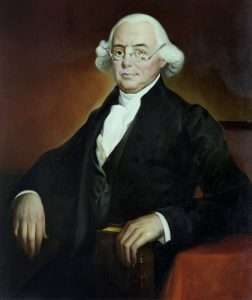
10/28/1787: James Wilson gives speech to the Pennsylvania ratification convention about the need for a Bill of Rights.

Justice James Wilson
Via Law http://www.rssmix.com/

[Eugene Volokh] Nothing Says "Free to Be Me" Like Compulsory Pansexuality

["Is a lesbian transphobic if she does not want to have sex with trans women?"]

A remarkable story from the BBC, revealing a phenomenon that strikes me as utterly bizarre:

Jennie is a lesbian woman. She says she is only sexually attracted to women who are biologically female and have vaginas. She therefore only has sex and relationships with women who are biologically female.

Jennie doesn't think this should be controversial, but not everyone agrees. She has been described as transphobic, a genital fetishist, a pervert and a "terf"—a trans exclusionary radical feminist….

Another lesbian woman, 26-year-old Chloe*, said she felt so pressured she ended up having penetrative sex with a trans woman at university after repeatedly explaining she was not interested.

They lived near each other in halls of residence. Chloe had been drinking alcohol and does not think she could have given proper consent.

"I felt very bad for hating every moment, because the idea is we are attracted to gender rather than sex, and I did not feel that, and I felt bad for feeling like that," she said.

Ashamed and embarrassed, she decided not to tell anyone….

One woman reported being targeted in an online group. "I was told that homosexuality doesn't exist and I owed it to my trans sisters to unlearn my 'genital confusion' so I can enjoy letting them penetrate me," she wrote.

My view:

  1. People who want to have sex with you may indeed try to make you feel bad for not agreeing.
  2. "You owe it to someone to enjoy letting me penetrate you" is a very old story.
  3. It's just not clear to me how this gives them the moral high ground.
Via Law http://www.rssmix.com/