Saturday, October 30, 2021

[Eugene Volokh] Guns, Background Checks, Administrative Law, and the Sixth Circuit Michigan Case

The Sixth Circuit is considering a very interesting gun case; unfortunately, I haven't been following it closely, largely because it's a technical statutory and regulatory case rather than a Second Amendment case—but Prof. Robert Leider (George Mason), who guest-blogged here on a different subject a few months ago, has been, and kindly offered this analysis:

In gun control debates, the Second Amendment usually takes center stage. But more mundane questions of statutory interpretation and administrative law can have more impact on gun owners.

On Tuesday, the U.S. Court of Appeals for the Sixth Circuit heard oral argument in one such case, Gun Owners of America, Inc. v. Department of Justice. The appeal relates to a March 3, 2020 declaration by the Bureau of Alcohol, Tobacco, Firearms, and Explosives (ATF) that Michigan's concealed pistol license holders are no longer exempt from the national instant background check before the sale of a firearm because the Michigan State Police do not adequately research previous criminal convictions to determine whether a license applicant is prohibited from possessing a firearm. (ATF also undertook a similar action against Alabama pistol permit holders.)

Under the Brady Handgun Violence Protection Act, a federal firearms licensee (e.g., a gun store) must initiate a background check through the National Instant Check System before transferring a firearm. The law contains some exceptions, the most important of which is that a licensee may transfer a firearm to a person who has a permit that "was issued not more than 5 years earlier by the State in which the transfer is to take place" if that permit "allows such other person to possess or acquire a firearm" and "the law of the State provides that such a permit is to be issued only after an authorized government official has verified that the information available to such official does not indicate that possession of a firearm by such other person would be in violation of law."

Traditionally, ATF has declared whether state permits qualify as instant check alternatives by publishing a "Permanent Brady Permit Chart" online and in a "Public Safety Advisory" to a state's federal firearm licensees. In regulating through these informal mechanisms, ATF is doing one of two things, and both are procedurally problematic under the Administrative Procedure Act.

The first possibility is that despite ATF's portrayal of the letters and permit charts as binding, they actually constitute non-binding sub-regulatory guidance from ATF to Federal Firearm Licensees. If that is the case, Michigan gun stores could just ignore ATF's letter and continue accepting Michigan concealed pistol licensees as alternatives if they were certain that the licenses met the requirements of the Brady Act.

The second possibility—what ATF is likely doing—is issuing binding rules (or conducting binding adjudication) without public notice and comment and without the opportunity of affected stakeholders to participate. ATF's letter, which announces "an important change to the procedure [federal firearms licensees] must follow to comply with the Brady [law]," suggests that when ATF determines that a permit does not qualify, ATF considers its determination as legally binding. If so, ATF's determination is "one by which rights or obligations have been determined, or from which legal consequences will flow."

Yet, before making changes to the Brady Permit Chart, ATF does not engage in notice and comment, nor does it engage in adjudication in which federal firearms licensees and permit holders—the affected stakeholders—may participate. Regardless of the merits of ATF's actions, ATF is flouting the Administrative Procedure Act, and I was surprised that the Sixth Circuit panel did not press the government on this issue.

Two other major issues came up during oral argument that deserve further comment.

Standing: Why ATF's Actions Have Significant Real-World Impact

The Sixth Circuit is apparently struggling with whether the plaintiffs have standing under Article III. Although the federal government has revoked the federal legal effect of their state-issued firearm licenses, the plaintiffs have another ready alternative to purchase firearms by submitting to the federal instant check system. The government contends that submission to the instant check does not create sufficient real-world injury to constitute injury-in-fact.

Here, the plaintiffs have unnecessarily convoluted the standing question by not articulating to the court the practical significance of ATF's revocation. The use of a license as a substitute for the instant background check confers two important benefits upon license holders. First, it prevents the possibility that a gun purchaser will face significant delays in acquiring a firearm. About 10% of "instant" checks are not actually instant, and just under 1% take longer than three business days to resolve. Once a check is initiated, federal law permits the firearm to be transferred after three business days have elapsed. But that means individuals could still face delays of up to five days before they can take possession of their firearm. Those delays may not be a significant burden if the gun store is local. But if a person is traveling a substantial distance to a gun store or gun show, that delay could require a second, long trip to retrieve the firearm. When individuals seek to purchase a firearm, having a permit removes all uncertainty about the transaction being delayed.

Second, the permit allows individuals to engage in intrastate mail-order firearm sales. In response to the assassinations of John F. Kennedy and Martin Luther King, Jr., Congress banned the interstate mail-order sale of firearms in 1968. But Congress allowed intrastate mail-order sales to continue if allowed by state law, and there has been renewed interest in intrastate mail-order sales because the coronavirus pandemic has limited access to gun stores.

In 1993, the Brady Act effectively stopped most intrastate mail-order sales because the Act required individuals to present photo identification before the gun store may initiate the instant check. When an individual has a permit exempting the person from the Brady Act's instant check requirement, however, then the Brady Act's requirement to provide photo identification at the gun store also does not apply. Instead, the purchaser may submit a Firearm Transaction Record (Form 4473) by mail along with a copy of their permit. The gun store may then transfer the firearm by mail after contacting the purchaser's local law enforcement agency and observing a lengthy waiting period. When ATF determines that a state's permit does not exempt the permit holder from the Brady law, ATF also cuts off the ability to use that permit to facilitate a mail-order sale.

Should the Court Defer to the Michigan Attorney General's Understanding of State Law?

Michigan law (§ 28.425b(6)) provides that the "department of state police shall verify" whether a person is qualified under law to receive the license by using information accessible "through the law enforcement information network and the national instant criminal background check system." When the Michigan State Police receives ambiguous criminal history records, they have refused to conduct exhaustive investigations into whether the applicant is prohibited from having a license. The refusal to conduct such investigations prompted ATF's withdrawal of concealed pistol licenses as an alternative to the instant check system. During oral argument, the panel (particularly Judge Sutton) seemed troubled that ATF was deferring to some unnamed person in the state police to authoritatively determine what Michigan law requires the state police to do when conducting a background check. He suggested asking the Michigan Attorney General for her views. In this case, however, deferring to the Attorney General's understanding of the law would be a mistake.

The Michigan Attorney General should not be viewed as a neutral, authoritative source to determine the meaning of Michigan law. The Michigan Attorney General is a strong proponent of gun control. Gun control groups seek to narrow the exceptions of the federal instant check system because of the possibility that information could grow stale between the time that the permit was issued and when a person seeks to buy a gun. In this case, the Michigan Attorney General is incentivized to opine that Michigan law does not require the state police to conduct exhaustive background checks to prevent concealed pistol licenses from being acceptable alternatives to the federal background check.

Federal courts sometimes face difficult state-law interpretive questions. But no less than in federal-law cases, a federal court's job is to interpret state law, not to try to delegate its task to a state executive official. That is particularly true in this case, in which the Attorney General would not be a neutral arbiter of state law. If the panel insists on having the state interpret its own laws, the more appropriate course of action would be to certify the question to the Michigan Supreme Court.

More broadly, this case raises difficult questions concerning what properly constitutes "the law of the State." The federal Gun Control Act exempts state permits if "the law of the State" requires an adequate background check. What is the "law of the State"? The statute? The statute as implemented by binding executive regulations? Or does the real-world practice of state officials constitute "the law of the State," even if that practice violates state statutes?

Here, I think the statutes should have primacy over executive practice. The plain statutory text of Michigan law indicates its concealed pistol licenses should qualify as alternatives to the national instant check system. Although executive agencies may engage in unlawful behavior when they implement the law, neither they, nor the Attorney General, has the power to rewrite the law passed by the legislature. And the Brady Act contains no language disqualifying all state permits just because some licensing official implements the law in a faulty manner.

Via Law http://www.rssmix.com/

[David Bernstein] The Nonsensical "Asian American" Classification

[It makes no sense to treat people with such a wide range of ancestries as a monolithic group.]

Kao Lee Yang, a Hmong American neuroscience PhD student, was recently nominated for a prestigious fellowship for students who are members of "groups historically excluded from and underrepresented in science." The fellowship committee determined that as an Asian American, Yang was not from an "underrepresented" group. The committee therefore refused to even consider her application.

Yang took to Twitter to vent: "While some Asian Americans are academically successful, others like the Hmong are underrepresented in STEM and academia in general… name me just one Hmong American woman you know who is a neuroscientist. I would love to connect with her if she is out there." She added, "I am an example of the consequences resulting from the continued practice of grouping people with East/Southeast/South Asian heritages underneath the 'Asian American' umbrella."

Yang blamed her predicament on the "model minority myth."  Her ire would have been better targeted at the federal Department of Education. For over forty years, its Office of Civil Rights has required educational institutions to collect and report demographic data about "Asian Americans," with no differentiation among the many national-origin groups. The educational establishment, in turn, has grown used to treating Asian Americans as a uniform racial group.

Of course, one can object that no minorities should be given special consideration for fellowship. Or that only African Americans should be given such consideration, but not groups composed mostly of post-1965 immigrants and their descendants. But it's pretty hard to argue that an Argentine American of Italian descent should be eligible for a minority fellowship because she is "Hispanic," but a Hmong American should not because she is "Asian."

You can read more about how our modern racial and ethnic classifications developed in my recently published article, The Modern American Law of Race, or you can wait for my book, Classified: The Untold Story of Racial Classifications in America, forthcoming July 2021.

Via Law http://www.rssmix.com/

[Josh Blackman] Today in Supreme Court History: October 28, 1787

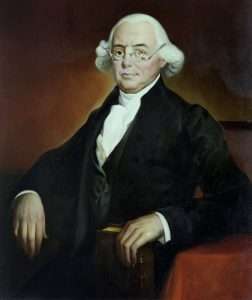
10/28/1787: James Wilson gives speech to the Pennsylvania ratification convention about the need for a Bill of Rights.

Justice James Wilson
Via Law http://www.rssmix.com/

[Eugene Volokh] Nothing Says "Free to Be Me" Like Compulsory Pansexuality

["Is a lesbian transphobic if she does not want to have sex with trans women?"]

A remarkable story from the BBC, revealing a phenomenon that strikes me as utterly bizarre:

Jennie is a lesbian woman. She says she is only sexually attracted to women who are biologically female and have vaginas. She therefore only has sex and relationships with women who are biologically female.

Jennie doesn't think this should be controversial, but not everyone agrees. She has been described as transphobic, a genital fetishist, a pervert and a "terf"—a trans exclusionary radical feminist….

Another lesbian woman, 26-year-old Chloe*, said she felt so pressured she ended up having penetrative sex with a trans woman at university after repeatedly explaining she was not interested.

They lived near each other in halls of residence. Chloe had been drinking alcohol and does not think she could have given proper consent.

"I felt very bad for hating every moment, because the idea is we are attracted to gender rather than sex, and I did not feel that, and I felt bad for feeling like that," she said.

Ashamed and embarrassed, she decided not to tell anyone….

One woman reported being targeted in an online group. "I was told that homosexuality doesn't exist and I owed it to my trans sisters to unlearn my 'genital confusion' so I can enjoy letting them penetrate me," she wrote.

My view:

  1. People who want to have sex with you may indeed try to make you feel bad for not agreeing.
  2. "You owe it to someone to enjoy letting me penetrate you" is a very old story.
  3. It's just not clear to me how this gives them the moral high ground.
Via Law http://www.rssmix.com/

Thursday, October 28, 2021

"Federal Offenders Who Served in the Armed Forces"

Cover_armed-forcesThe title of this post is the title of this fascinating new report from the US Sentencing Commission released today.  This USSC webpage provides this overview and key findings:

The Department of Veterans Affairs estimates that there are more than 19 million Americans who are veterans. Over 10,000 veteran offenders were in the custody of the Federal Bureau of Prisons at the end of 2019, accounting for almost six percent of all BOP inmates.

This report provides an analysis of the relatively small number of veterans each year who are sentenced for a federal felony or Class A misdemeanor offense, most often committed well after they left military service.  In particular, the report examines federal offenders with prior military service who were sentenced in fiscal year 2019, the crimes they committed, and an assessment of whether that prior service was given special consideration at sentencing.

Key Findings

  • In fiscal year 2019, 4.4 percent of all U.S. citizens sentenced in the Federal courts for a felony or Class A misdemeanor had served in the military.  For these offenders, the average length of time between separation from the military and the sentence for the federal offense was 23 years.

  • The most common crime type committed by both veteran offenders and citizen offenders overall was drug trafficking (25.0% and 37.6%, respectively).  Veteran offenders, however, committed child pornography offenses more than four times as often as citizen offenders overall, 11.6 percent compared to 2.7 percent, and sex abuse offenses more than twice as often, 6.7 percent compared to 2.4 percent.

  • The sentences imposed on veteran offenders and citizen offenders overall were similar in terms of type of sentence imposed and average sentence imposed.  For veteran offenders, 79.2 percent received a sentence of imprisonment compared to 83.9 percent of all citizen offenders, and the average sentence for veteran offenders was 64 months compared to 62 months for all citizen offenders.

  • Although veteran offenders were more likely to be sentenced below the applicable guideline range (38.9% received a downward variance compared to 31.8% of all citizen offenders), military service does not appear to have a significant influence on the sentences imposed.  The court specifically cited an offender’s military service as a reason for the sentence imposed in only 15.0 percent of cases involving veteran offenders.

  • When the court did cite an offender’s military service as a reason for the sentence, it was almost always for service that the military had characterized as honorable.

  • Only two other offender characteristics were correlated with sentences where a court cited the offender’s military service as a reason.  Two-thirds (66.9%) of the offenders whose military service was cited by the court indicated that they had some history of mental health problems, compared to 51.1 percent for veteran offenders generally.  Also, more than half (54.8%) of the offenders whose service was cited by the court had served in a combat zone, compared to 22.6 percent for all veteran offenders.

Via Law http://www.rssmix.com/

BJS releases "Federal Justice Statistics, 2019" with immigration and drugs dominating federal dockets

Via email this morning I learned of the release of this notable new data report from the Bureau of Justice Statistics titled simply "Federal Justice Statistics, 2019."  The email summarized the report this way:

This report, the 33rd in an annual series which began in 1979, provides national statistics on the federal response to crime. It describes case processing in the federal criminal justice system for fiscal year 2019, including—

  • investigations by U.S. attorneys
  • prosecutions and declinations
  • convictions and acquittals
  • sentencing
  • pretrial release
  • detention
  • appeals
  • probation and parole
  • prisons.

Findings are based on BJS’s Federal Justice Statistics Program (FJSP).  The FJSP collects, standardizes, and reports on administrative data from six federal justice agencies: the U.S. Marshals Service, Drug Enforcement Administration, Administrative Office of the U.S. Courts, Executive Office for U.S. Attorneys, Federal Bureau of Prisons, and U.S. Sentencing Commission.

Covering a period from Oct. 1 2018 to Sept. 30, 2019, this report captures the last full yearly snapshot of the federal criminal justice system before COVID hit in early 2020.  And, though federal data always reveal that the modern federal justice system is focused particularly on immigration and drug cases, these new data from the report still paint a notable picture of our federal criminal justice system in operation while highlighting how arrest patterns and sentencing patterns diverge for the two biggest crime categories:

During FY 2019, 8 in 10 federal arrests were for immigration, drug, or supervision violations (165,123). Immigration (117,425 arrests) was the most common arrest offense in FY 2019.  More than half (57%) of federal arrests involved an immigration offense as the most serious arrest offense.  The next most common arrest offenses were for drug offenses (12% of all arrests) and supervision violations (11%)....

In FY 2019, a total of 58,886 federally sentenced persons were admitted to federal prison.  Of these, 45,425 entered federal prison on U.S. district court commitments.  Another 13,461 persons were returned to federal prison for violating conditions of probation, parole, or supervised release, or were admitted for a reason other than a U.S. district court commitment.  In FY 2019, 21,075 persons entered federal prison for drug offenses, most of whom (15,574, or 74%) had been sentenced to more than 1 year.

In 2009 and 2019, most people in federal prison were serving time for a drug offense.  Persons with a drug offense as the most serious commitment offense made up 47% of the prison population at fiscal year-end 2019, down from 53% at fiscal year-end 2009.  Persons serving time for a weapon offense increased from 15% of the prison population in 2009 to 19% in 2019.  Persons serving time for a violent offense remained at 6% in 2009 and 2019, and persons serving time for an immigration offense decreased from 12% in 2009 to 6% in 2019.

Via Law http://www.rssmix.com/

Wednesday, October 27, 2021

[Jonathan H. Adler] Fifth Circuit Rebukes FDA for Regulatory "Switcheroo" in Denying Vaping Product Applications

15818510247_cf49a3e470_k

[Yesterday's decision eviscerated the Food and Drug Administration for its arbitrary and capricious handling of vaping product applications ]

In 2016 the Food & Drug Administration "deemed" electronic cigarettes, vaping pens, and other electronic Nicotine delivery systems ("ENDS") to be "tobacco products" under the Family Smoking Prevention and Tobacco Control Act. As a consequence, all ENDS manufacturers were required to submit premarket tobacco applications (PMTAs) in order to continue selling their wares. Under the Tobacco Act, the FDA is only to approve a PMTA if it concludes approval is "appropriate for the protection of public health," taking into account "the risks and benefits to the population as a whole." Without a PMTA, a deemed tobacco product cannot be sold.

PMTAs are supposed to be submitted before a new tobacco product is sold, but this was impossible since the FDA's rule applied to products already on the market. Accordingly, the FDA announced that ENDS manufacturers would have two years to prepare and submit the lengthy and detailed materials necessary for their applications before they would face the prospect of FDA enforcement. The FDA soon realized that the material and information necessary for PMTAs would be substantial, particularly because a separate PMTA is required for each product, defined quite capaciously (i.e. each package size, each flavor, each nicotine level, each delivery system, etc.). So the FDA tried to extend the enforcement deadline until 2022, but anti-smoking groups sued, and they settled on a 2020 deadline.

The FDA ultimately received applications for over 4.8 million ENDS products from 230 companies. Needless to say, this is a bit more than the agency anticipated, and it has been working to process the applications, denying most of them. Because a PMTA denial is a death sentence, some disappointed ENDS producers have filed suit, challenging the denials and seeking judicial orders blocking FDA enforcement in the meantime.

Yesterday, the U.S. Court of Appeals for the Fifth Circuit ruled on one company's application for a stay pending resolution of its petition challenging the FDA's denial of its PMTAs. The court's opinion in Wages and White Lion Investments LLC v. USFDA (WWLI) is a blistering indictment of the agency's decision-making and evaluation of ENDS PMTAs.

In WWLI a unanimous panel granted Triton Distribution's application for a stay, concluding that  it had demonstrated not only a strong likelihood of success on the merits, but also that it would suffer irreparable injury without a stay, and the government would not.

A key problem with the way that the FDA handled the PMTAs filed by Triton (and other ENDS manufacturers) is that the FDA based its denial of their applications on a different standard than it had told companies they have to meet. This sort of action is at the heart of arbitrary agency action, and is antithetical to principles of due process.

For years, the FDA had informed ENDS manufacturers that they would not need to conduct long-term health studies on their individual products for their applications. This only makes sense, as ENDS manufacturers only had a limited period of time to prepare their materials. Yet, on August 26 when the FDA announced it was denying PMTAs for 55,000 flavored e-cigarette products, it claimed that such studies were "likely" necessary for approval. A few weeks later, the FDA denied Triton's applications, explaining that the key basis" for the denial, was the lack of "robust and reliable evidence" from long-term studies of the sort FDA had previously told manufacturers were unnecessary. (Triton had nonetheless committed to conduct such studies, but the FDA refused to consider that assurance.)

As Judge Oldham's opinion makes clear, the FDA's decision-making in denying Triton's application is an almost textbook example of what agencies are not supposed to do. It both changed course without adequate explanation or consideration of serious reliance interests while simultaneously refusing to consider multiple relevant factors and information submitted by Triton.

Here are a few examples from Oldham's opinion:

The FDA failed to reasonably consider Triton's proposed marketing plan. The FDA repeatedly stated that a marketing plan is "a critical factor in[] FDA's statutorily required determination." Premarket Tobacco Product Applications and Recordkeeping Requirements, 86 Fed. Reg. 55,300, 55,324 (Oct. 5, 2021) ("Final Rule"); see also 84 Fed. Reg. 50,566, 50,581 (Sept. 25, 2019) ("Proposed Rule") ("The applicant's marketing plans . . . will provide input that is critical to FDA's determination of the likelihood of changes in tobacco product use behavior, especially when considered in conjunction with other information contained in the application." (emphasis added)); A.45 n.xix ("Limiting youth access and exposure to marketing is a critical aspect of product regulation." (emphasis added)); A.45 (Premarket "assessment includes evaluating the appropriateness of the proposed marketing plan."). Here, however, the FDA simply ignored Triton's plan. It stated: "[F]or the sake of efficiency, the evaluation of the marketing plan in applications will not occur at this stage of review, and we have not evaluated any marketing plans submitted with these applications."

The FDA's excuses for ignoring the "critical factor" of Triton's marketing plan are unpersuasive. First, the FDA says it didn't evaluate Triton's plan for "the sake of efficiency." Ibid. But "efficiency" is no substitute for "reasoned decisionmaking." Michigan, 576 U.S. at 750; see also Judulang v. Holder, 565 U.S. 42, 64 (2011) (emphasizing that "cheapness alone cannot save an arbitrary agency policy"). . . .

In a footnote Judge Oldham notes that the FDA's failure to consider Triton's marketing plan, and how it would control youth access, was particularly striking given that then-FDA Commissioner Scott Gottleib had identified Triton's approach as "best practices."

And then there are Trtiton's reliance interests, which the FDA disregarded in the course of its regulatory "switcheroo."

Between the Deeming Rule's effective date and the deadline for PMTAs, the FDA held public meetings and issued guidance on how e-cigarette manufacturers could get premarket authorization. In its "final guidance," the FDA stated that it did not "expect" that tobacco manufacturers would need to conduct long-term studies to support their PMTA. See, e.g., A.73–74; A.92; see also Nicopure Labs, LLC v. FDA, 944 F.3d 267, 282 (D.C. Cir. 2019) ("The FDA has expressed willingness to accept scientific literature reviews instead of commissioned studies in support of e-cigarette applications in appropriate circumstances."). The FDA's expectation did not deviate in its Proposed Rule issued before the Order or the Final Rule issued a couple weeks after the Order. See Final Rule, 86 Fed. Reg. at 55,387 ("FDA does not expect that long-term clinical studies will need to be conducted for each PMTA; instead, it expects that it should be able to rely on other valid scientific evidence to evaluate some PMTAs."); Proposed Rule, 84 Fed. Reg. at 50,619 (similar). Many e-cigarette companies relied on the FDA's repeated insistence that it did "not expect that applicants will have to conduct long-term studies to support an application" and did not perform or submit such evidence.

Then the FDA "pull[ed] a surprise switcheroo on regulated entities." Env't Integrity Project v. EPA, 425 F.3d 992, 996 (D.C. Cir. 2005) (Sentelle, J.); accord Azar v. Allina Health Servs., 139 S. Ct. 1804, 1810 (2019) (citing the "surprise switcheroo" doctrine). Almost a year after the PMTA deadline, the FDA issued its first marketing denial orders for various flavored e-cigarettes and announced that it required the very studies it originally expected it didn't need. . . . Despite the radical difference, the FDA never mentioned, let alone reasonably considered, whether e-cigarette manufacturers, like Triton, could've reasonably relied on the FDA's prior meetings and guidance.

The law requires more. "When an agency changes course, . . . it must be cognizant that longstanding policies may have engendered serious reliance interests that must be taken into account." Regents, 140 S. Ct. at 1913 (quotation omitted). This does not mean that the FDA could not have "determine[d], in the particular context before it, that other interests and policy concerns outweigh any reliance interests. Making that difficult decision was the agency's job, but the agency failed to do it." Id. at 1914. This reinforces that the Order was likely arbitrary, capricious, or otherwise unlawful.

The FDA further failed to consider Triton's reliance interests, whether there were alternatives to denial on this basis, and other evidence submitted by Triton. As Judge Oldham noted, the FDA responded more to some of Triton's claims before the Fifth Circuit than it had when rejecting Triton's PMTA. The court also found that that, on balance, a majority of the other relevant factors favored granting Triton's request for a stay

The opinion also rejected the government's (in my view, borderline frivolous) argument that the Triton sought relief -- a stay of FDA enforcement action -- that the court could not give. Yet just as a court could issue a stay barring the deportation of an unlawfully present alien pending review of the alien's claim for asylum or lawful presence, a court may order an administrative agency defendant to preserve the status quo pending the outcome of the litigation. How a government attorney argued the alternative is beyond me, particularly given the innovative arguments in favor of expansive judicial authority to enter stays the federal government is currently making in the S.B. 8 litigation (something which I doubt was lost on this panel).

The Fifth Circuit's WWLI decision indicates the FDA faces a tough road ahead defending many of its PMTA denials--and it appears the FDA knows it. Other manufacturers have also sought relief in court, and even before the Fifth Circuit's decision issued the FDA was already beginning to back down. For instance, on October 11, in the face of a pending stay request before the U.S. Court of Appeals for the Sixth Circuit, the FDA agreed to rescind its denial of PMTAs submitted by Turning Point Brands.

What is particularly galling about the FDA's treatment of ENDS manufacturers is that the FDA is well-aware that ENDS products pose far less risk to users than traditional, combustible cigarettes, and has acknowledged that ENDS can help some smokers quit. Further, there is substantial evidence that limitations on ENDS products will increase smoking, particularly among youth (as has been well-documented). Thus the FDA's cavalier rejection of PMTAs is not only arbitrary and capricious, it is contrary to the FDA's underlying public health mission (and may also be unconstitutional).

Via Law http://www.rssmix.com/